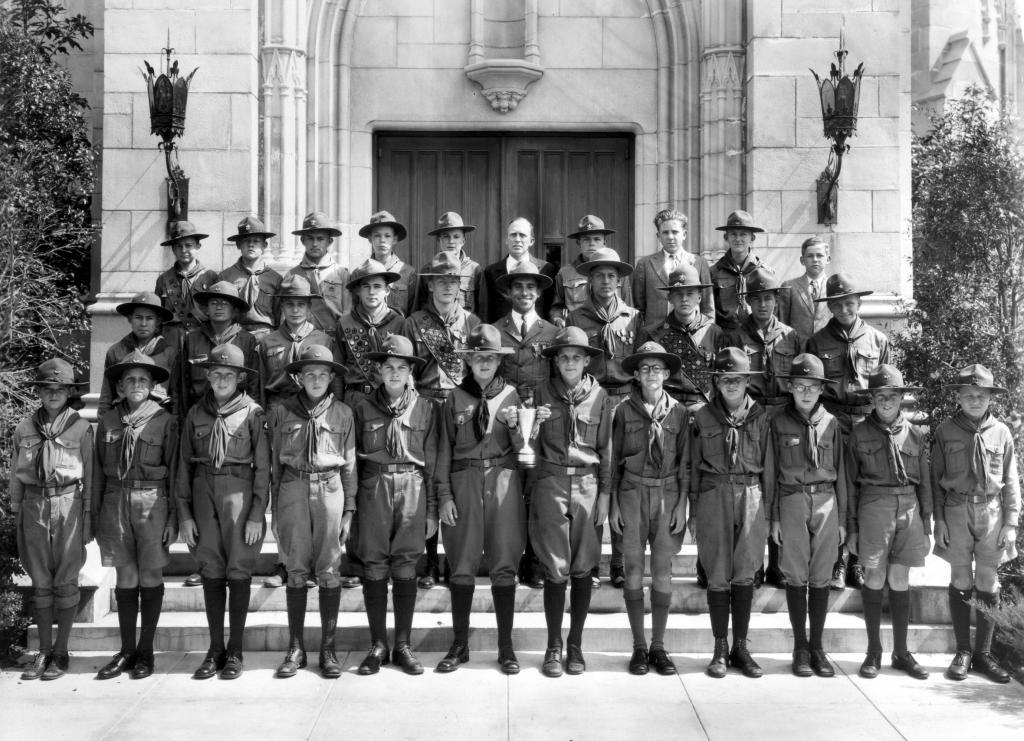
Welcome to the BSA and Troop 4 History page. On this page we hope to tell you about scouting in the early years and how it has become so large. This information has been taken from Boys' Life magazine.
Scouting began in 1907 when Sir Robert Baden-Powell, a retired Lieutenant-General of the British Army, took 20 boys on a camping trip to Brownsea Island. A year later Baden-Powell published the first Boy Scout handbook, "Scouting for Boys."
In 1909, Mr. William D. Boyce, an American publisher visiting London, England, was helplessly lost in a heavy fog that covered the city. A young boy dressed in uniform approached him and asked if he might be of help. Mr. Boyce told the boy where he wanted to go and the lad took him straight to his destination. The boy refused Mr. Boyce's tip saying, "Scouts do not accept tips doing good turns. Haven't you heard of Baden-Powell's scouts?" Mr. Boyce was much impressed and questioned the boy about the movement. The lad told him all he knew and took him to Baden-Powell's offices. Then the boy disappeared. Returning to America, Mr. Boyce incorporated the Boy Scouts of America under the Laws of The District of Columbia on February 8, 1910.
On June 21st, 34 men started organization plans, with President Taft as Honorary President.
1911 - On Jan 2, National Council offices were opened in New York. James E. West became the first Chief Scout Executive. The Scout Oath, Law and badges were adopted. The National Court of Honor gave out the first Heroism awards. Membership: 61,495 Scouts and Scouters.
1912 - Scouts from every state are now enrolled; the first National Good Turn was started ("A Safe and Save Fourth of July"), Sea Scouting was established and Boy's Life became the official BSA magazine.
1913 - Dr. Clarence Spaulding, a student at Oxford University became acquainted with Lord Baden-Powell and worked with him in the Scouting movement between 1908 and 1911. Dr. Spaulding returned to the United States determined to start a Boy Scout troop. He became the minister of Westminster Presbyterian Church in 1912 and founded Troop 4 in June, 1913.
Over more than 95 years, Troop 4 has been the longest continuously charted troop in the San Gabriel Valley. There have been over 41 Scoutmasters, 202 Eagle Scouts, and over 2,400 Scouts in the troop. Troop 4 serves local youth with a program that emphasizes personal development, outdoor adventure, and service to others.
Headlines:
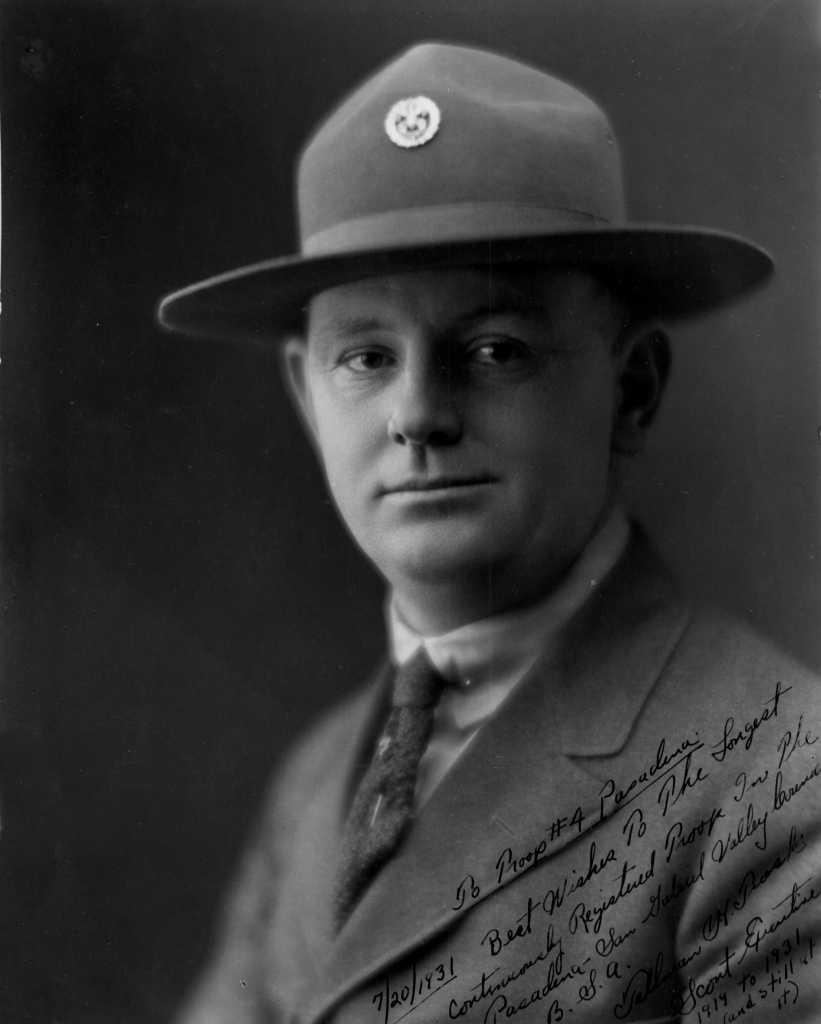 Trask Talks About The Cave(Tallman Trask, First San Gabriel Valley Council Exec at Troop 4's 50th Anniversary)"One of the real memories that Troop 4 has to me was the old cave... We used to come in off of Woodbury Road and there was a stone entrance to a cave...you go down that entrance on a ladder and underneath the corner of the old church there was the most beautiful troop room that you ever saw. It was all down underground and underneath the church... I think maybe if someone could dig up the old records there might be mention of that old cave because it was known as "the cave". It was a great pleasure to be here for Troop 4's 50th anniversary, and although I'm 76, I hope to be here for your 100th."
Scoutmaster in Trouble(Hobert Barnes, Scoutmaster 1923, at Troop 4's 50th Anniversary)"Only tonight did I discover the first case where one of our Scouters had not been a good conservationist on the trail...the founder of this troop was taken in for leaving a fire burning in the woods. He will have to speak for himself. This is a joke of course." (Ed. note - We think "joke" means "funny story", and that this was an actual event.)(Spaulding, responding to Barnes) "The Pasadena Star News came out one day and it noted that...the minister of Westminster Presbyterian Church and Scoutmaster of Troop 4 was arrested for leaving his campfire and not putting it out. I was summoned to court and in the congregation I had a very famous lawyer, one of our members, Mr. Barton, who had been president of the Bar Association for our county. He advised me to plead not guilty. I said, 'Well, I'm a Scout and I was up there and they said they found the coals still burning. We had gotten up at 6 am and had breakfast and washed the dishes in front of the fire and it was 9 am when we left. I didn't think about looking for coals. I though they'd all be out.'"So we went down to the judge and when the citation was read...now we were up there on July 27 (Ed. possible years 1918, 1929, 1935, 1940, 1946...)... the citation for leaving the fire was dated on Monday July 29. We weren't there on Monday so the case was dismissed, but I got the publicity and this guy is trying to make out like I left the fire burning..."